Sidewalk Lifting — Scottsdale Specialist
Sidewalk & Walkway Trip-Hazard Lifting in Scottsdale
A raised sidewalk edge isn't a cosmetic problem — it's a documented trip hazard and, in most Arizona cities, the adjacent property owner's exposure. We lift the flag back to grade, log the correction, and don't try to sell you anything else.
Why a raised sidewalk flag is a liability problem, not just a trip
Under ADA standards, any vertical change of 1/4 inch or more in a walking surface counts as a trip hazard. Edges between 1/4 and 1/2 inch have to be beveled at a 1:2 ratio; anything past 1/2 inch calls for re-leveling or a ramp. Most Arizona municipalities — Scottsdale included — place responsibility for the adjoining public sidewalk on the property owner, not the city, which turns a raised flag into an open liability item sitting in your front yard.
The good news: a single raised flag is almost never a whole-sidewalk problem. One panel settles, the next one doesn't, and you get a step where there should be a flat surface. That's a lifting problem, not a demolition problem — and it's the exact scope we specialize in.
- Any lip or step of 1/4 inch or more between adjoining sidewalk sections
- Sidewalk pulling away from a driveway apron or garage transition
- A section that rocks or drums when stepped on — usually a sign of a void underneath
- Standing water on a flag that used to drain
Why Scottsdale sidewalks settle unevenly
Sidewalk sections are narrow, shallow slabs poured directly over compacted subgrade — which means they're some of the most sensitive concrete on the property to what's happening in the soil underneath. Scottsdale's mix of caliche hardpan and expansive clay pockets means one panel can sit on a firm caliche shelf while its neighbor sits on soil that shrank during the dry season and swelled with the next monsoon. The result is the classic stair-step you see along older sidewalks and HOA common-area walks alike.
How we lift a single sidewalk section
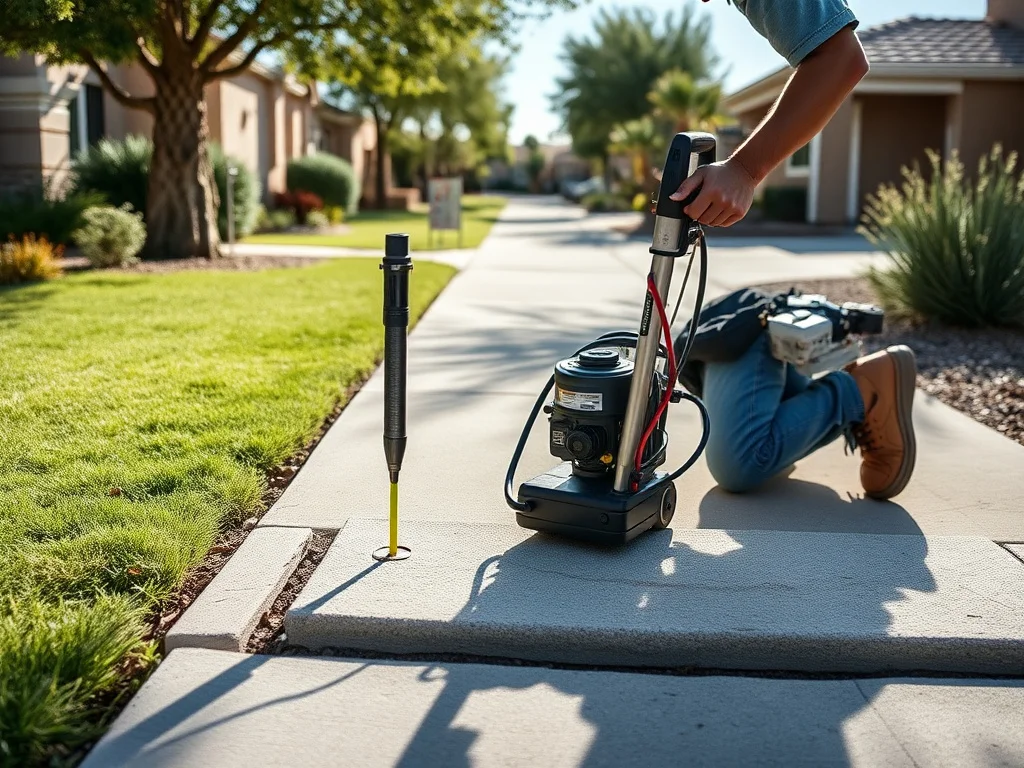
We drill a small pattern of dime-size holes in the low panel, inject foam underneath in controlled shots, and raise it to match the flush height of its neighbors — usually in under an hour per section. Holes are patched with color-matched mortar and the joint is caulked so the fix doesn't just wash back out with the next storm.
Because it's one method and no demolition, there's no jackhammer, no rebar cutting, and no waiting on a new pour to cure before the sidewalk is usable again. You can walk on it minutes after we finish.
What sidewalk lifting costs
Leveling a single flag or a short run of sidewalk (roughly 50–150 square feet) typically runs a few hundred dollars per raised section with polyurethane injection — a fraction of what one trip-and-fall claim or a city-ordered repair notice can cost a property owner. Larger HOA or commercial walkway programs are priced per linear foot after an on-site survey.
HOA and commercial walkway survey programs
For HOA boards and property managers, we run a walk-and-measure survey against the 1/4-inch ADA threshold across the whole common-area walkway network, then hand back a prioritized, fixed-price correction list with a dated log for your records. It's the same single method — injection lifting — applied at scale, with documentation your insurer or board minutes will want on file.
Get a sidewalk estimate
Send a photo of the raised edge and your address, or book a free inspection. Most single-flag lifts are quoted and scheduled within a day or two.
Sidewalk Trip-Hazard Lifting FAQs
Straight answers before we drill
Any vertical change of 1/4 inch or more in a walking surface is a trip hazard under ADA standards; edges between 1/4 and 1/2 inch must be beveled, and anything over 1/2 inch requires re-leveling or a ramp. We lift sidewalk flags back to within tolerance and document the correction.
In most Arizona cities, including Scottsdale, the adjacent property owner carries maintenance and liability responsibility for the public sidewalk fronting their lot — check your specific city code for the exact ordinance. Proactive leveling is dramatically cheaper than a trip-and-fall claim or a city repair notice.
Usually under an hour per section, start to finish. The foam reaches workable strength in about 15 minutes, so the walkway is usable again almost immediately.
Yes — we run walk-and-measure surveys against the ADA 1/4-inch threshold and return a prioritized, fixed-price correction list with a dated log, then lift each section in one pass.
Sunken concrete? Get it lifted this week.
Free estimates across Scottsdale. Most residential lifts finished in under a day — driveable in 15 minutes.